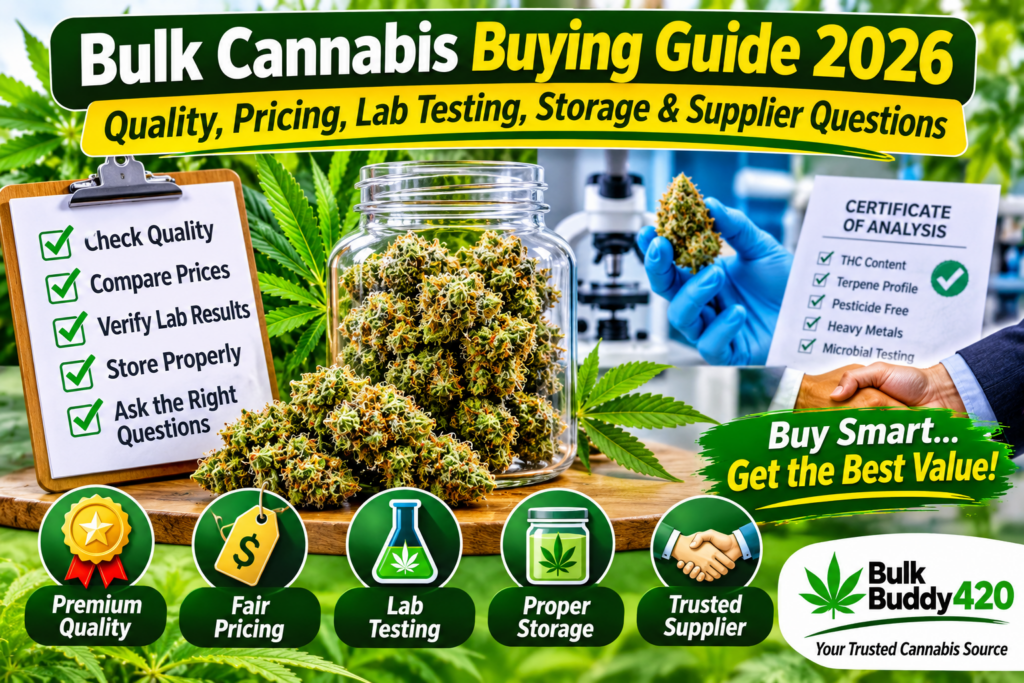
Bulk Cannabis Buying Guide 2026: Quality, Pricing, Lab Testing, Storage & Supplier Questions
Buying cannabis in bulk requires more than comparing prices or selecting the largest available quantity. Product quality, freshness, laboratory testing, supplier transparency, storage conditions, and applicable regulations all influence whether a purchase represents good value.
This bulk cannabis buying guide 2026 explains the important considerations when evaluating cannabis products and suppliers. Whether you are researching product quality, comparing wholesale quotations, or checking laboratory documentation, understanding these factors can help you make more informed decisions.
A reliable bulk cannabis buying guide 2026 should focus on verifiable product information rather than promotional claims. Buyers should understand what they are evaluating, what documentation to request, and which questions to ask before considering a transaction.
1. What Is Bulk Cannabis Buying?
Bulk cannabis buying generally refers to purchasing larger quantities of cannabis products through wholesale or volume-based arrangements rather than individual retail quantities. Depending on the legal market and supplier, product categories may include cannabis flower, concentrates, and other regulated cannabis products.
Bulk purchasing arrangements can differ in product grades, packaging, quantities, pricing structures, and transaction requirements. A larger quantity does not automatically guarantee better quality or value. Suppliers should be able to explain product specifications, batch information, pricing, and applicable testing documentation.
This bulk cannabis buying guide 2026 emphasizes the importance of understanding the product and its documentation before making comparisons.
2. How to Evaluate Cannabis Quality
Product quality should be one of the first considerations when evaluating a supplier. Promotional photographs and product descriptions can provide an initial impression, but they cannot independently establish freshness, laboratory quality, or the absence of contaminants.
A practical bulk cannabis buying guide 2026 should encourage buyers to consider several quality indicators together.
Appearance and Bud Structure
Cannabis flower can vary in size, density, structure, and coloration depending on genetics and cultivation methods. When reviewing product specifications or arranging a lawful inspection, consider:
- Whether the buds have a reasonably consistent appearance.
- Whether there is excessive loose plant material.
- Whether the flower appears unusually dry or damaged.
- Whether there are signs of visible contamination or mold.
- Whether the product description accurately represents the stated grade.
Appearance alone cannot confirm product safety. This bulk cannabis buying guide 2026 therefore recommends checking laboratory documentation as well as visual descriptions.
Aroma and Terpene Characteristics
Terpenes are aromatic compounds that contribute to the characteristic smell of cannabis flower. Product descriptions may refer to citrus, earthy, herbal, pine, fruity, sweet, or peppery aromas.
Aroma should be considered alongside laboratory information and storage history. An unusual musty smell or visible mold should be treated as a warning sign rather than ignored.
Indoor, Outdoor, and Greenhouse Flower
Cultivation methods can influence appearance, consistency, and production costs.
Indoor-grown flower: Cultivated in controlled indoor environments, with production costs and conditions that can vary between facilities.
Outdoor-grown flower: Cultivated outdoors using natural sunlight, with characteristics that can vary according to environmental conditions and agricultural practices.
Greenhouse-grown flower: Produced in greenhouse environments that combine natural light with varying levels of environmental control.
No cultivation method automatically guarantees superior quality. The actual product, cultivation standards, handling, and laboratory results matter more than the label alone. These distinctions are important when applying a bulk cannabis buying guide 2026 to product comparisons.
3. Understanding Bulk Cannabis Pricing in 2026
Pricing is an important consideration when comparing suppliers. However, the cheapest quotation is not necessarily the best value. Product grade, freshness, cultivation, packaging, testing, and supplier reliability can all influence the overall value of an offer.
This bulk cannabis buying guide 2026 recommends comparing equivalent products and transaction terms instead of choosing an offer based only on its advertised price.
What Influences Bulk Cannabis Prices?
Several factors can influence quoted prices:
- Product grade: Different grades may have different appearance, consistency, and market positioning.
- Cultivation method: Indoor, outdoor, and greenhouse production can involve different costs.
- Genetics and strain selection: Demand, availability, and cultivation characteristics can influence market positioning.
- Quantity: Volume-based pricing arrangements may vary, subject to applicable laws and supplier policies.
- Freshness: Packaging, storage, and product age can influence product condition.
- Laboratory testing: Testing and compliance requirements can contribute to production and distribution costs.
- Location and regulation: Taxes, legal requirements, transportation restrictions, and market conditions vary by jurisdiction.
How to Compare Supplier Quotes
When comparing quotations, make sure the products and terms are equivalent. A useful bulk cannabis buying guide 2026 should help readers identify the information that belongs in a clear quotation.
| Comparison factor | What to verify |
|---|---|
| Product name | Exact product or strain identity |
| Grade | Written grading specifications |
| Quantity | Clearly stated weight and measurement unit |
| Price | Total price and price per stated unit |
| Batch | Matching batch or lot identification |
| Testing | Available laboratory documentation |
| Packaging | Packaging format and condition |
| Delivery | Legally permitted delivery arrangements and responsibilities |
| Payment | Written terms and available protections |
A transparent quotation should identify the product and explain what is included in the quoted price. Avoid comparing two offers based on price alone when their product specifications differ.
4. Why Laboratory Testing Matters
Laboratory testing is an important part of evaluating cannabis products. A supplier’s potency claim should not replace independent, batch-specific laboratory documentation. A Certificate of Analysis, commonly called a COA, provides information about a sample tested by a laboratory.
In this bulk cannabis buying guide 2026, laboratory verification is treated as an essential part of assessing product information and supplier transparency.
What Should a Cannabis COA Include?
Depending on applicable regulations and testing requirements, a laboratory report may include:
- THC and CBD potency: Measured cannabinoid concentrations.
- Terpene profile: Measured aromatic compounds such as myrcene, limonene, caryophyllene, and pinene, when included in the testing panel.
- Pesticide screening: Testing for specified pesticide residues.
- Heavy metal testing: Screening for regulated metals such as lead, arsenic, cadmium, and mercury.
- Microbial testing: Testing for specified bacteria, yeast, and mold.
- Mycotoxin testing: Screening for certain toxins produced by particular molds.
- Residual solvent testing: Particularly relevant to applicable extracts and concentrates.
How to Verify a Certificate of Analysis
Before relying on a laboratory report, check the following information:
- The product name and sample description.
- The batch or lot number.
- The laboratory’s name and credentials.
- The testing date.
- The cannabinoid results.
- The terpene results, if included.
- The contaminant screening results.
- Whether the report applies to the actual product being evaluated.
A COA from an unrelated batch does not verify the quality of the product being offered. The bulk cannabis buying guide 2026 approach is to match the report to the actual product and batch rather than relying on a generic laboratory document.
For additional information, consult the California Department of Cannabis Control’s cannabis testing laboratory