
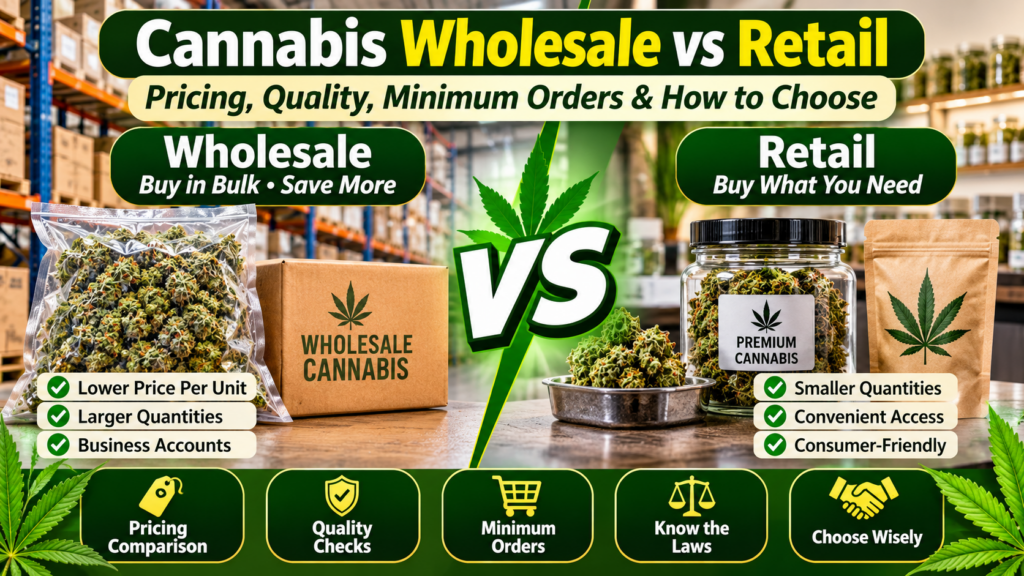
Cannabis Wholesale vs Retail: Pricing, Quality, Minimum Orders & How to Choose
Understanding cannabis wholesale vs retail is important for anyone researching how cannabis products move through the market, how prices are determined, and what separates wholesale transactions from individual retail purchases. Both channels serve different purposes, operate under different requirements, and can involve different pricing structures.
Whether you are researching the cannabis industry, comparing purchasing models, or learning how licensed businesses source inventory, this guide explains the key differences. We will examine pricing, product quality, minimum order quantities, supplier verification, and the factors that should influence an informed decision.
Before comparing the two models, remember that cannabis laws differ significantly between countries, states, and provinces. Wholesale purchasing and distribution may require specific business licences and regulatory approvals. Always confirm the rules that apply in your jurisdiction.
1. What Is Cannabis Wholesale?
Wholesale cannabis refers to the business-to-business supply of cannabis products through legally authorized producers, processors, distributors, and retailers. Instead of selling individual consumer units, wholesale transactions generally involve larger quantities supplied under commercial agreements.
In the cannabis wholesale vs retail market, wholesale distribution is an important part of the supply chain. Licensed producers may supply authorized distributors or retailers, depending on the regulations governing the market.
Wholesale transactions can involve dried flower, extracts, concentrates, and other permitted product categories. However, the products that can be supplied, the parties eligible to purchase them, and the documentation required depend on local regulations.
How Wholesale Distribution Works
- Licensed producers: Cultivate or manufacture cannabis products under applicable regulations.
- Processors: Prepare, package, test, or label products where required.
- Authorized distributors: Manage the movement of products through approved supply channels.
- Licensed retailers: Purchase eligible inventory for lawful retail sale.
Understanding this supply chain helps explain cannabis wholesale vs retail and why wholesale transactions often involve additional documentation, commercial requirements, and regulatory checks.
2. What Is Retail Cannabis?
Retail cannabis refers to products sold directly to eligible consumers through authorized stores or permitted online retailers. Retail purchases are generally made in smaller quantities and are intended for personal use where that use is lawful.
Unlike wholesale transactions, retail sales are usually priced per consumer package or unit. The final price may include operating expenses, distribution costs, applicable taxes, and other charges permitted by local law.
When comparing cannabis wholesale vs retail, the most noticeable difference is the customer. Wholesale transactions generally serve authorized businesses, while retail transactions serve eligible end consumers.
Common Retail Purchasing Features
- Smaller consumer-sized quantities.
- Individual product packaging and labelling.
- Prices displayed per unit or package.
- Consumer-facing product information.
- Age verification and other legal purchase requirements.
3. Cannabis Wholesale vs Retail: Main Differences
The differences between wholesale and retail extend beyond the amount purchased. They include the type of buyer, transaction requirements, pricing structure, documentation, and the role each channel plays in the supply chain.
| Comparison | Wholesale | Retail |
|---|---|---|
| Primary customer | Eligible licensed businesses | Eligible individual consumers |
| Purchase quantity | Generally larger commercial quantities | Usually smaller consumer quantities |
| Pricing structure | Commercial or negotiated pricing where permitted | Consumer-facing unit pricing |
| Documentation | May require licences, invoices, and supply records | Consumer receipt and required product information |
| Purpose | Commercial supply and inventory | Individual lawful purchase |
| Regulatory requirements | Business and distribution requirements may apply | Consumer eligibility and retail rules apply |
This comparison makes cannabis wholesale vs retail easier to understand. Wholesale is generally a commercial supply arrangement, while retail is the final consumer-facing stage of the market.
4. Cannabis Wholesale vs Retail Pricing: What Determines the Cost?
Pricing is one of the most discussed parts of cannabis wholesale vs retail. Wholesale prices and retail prices are not directly interchangeable because each reflects different costs, responsibilities, and stages of distribution.
Factors That Influence Wholesale Pricing
- Product category: Flower, extracts, concentrates, and other products can have different production and processing costs.
- Product quality: Consistency, appearance, moisture condition, aroma, and verified product specifications may influence commercial value.
- Production costs: Cultivation methods, labour, energy, processing, and packaging affect the cost of supply.
- Order volume: Larger commercial orders may have different unit pricing, depending on the supplier and applicable rules.
- Distribution expenses: Shipping, storage, handling, and insurance can affect the total cost.
- Taxes and regulatory charges: Applicable duties, taxes, and fees vary by jurisdiction.
Factors That Influence Retail Pricing
Retail prices can reflect the original product cost as well as store operations, packaging, distribution, local taxes, and other permitted expenses. Retailers may also operate under specific pricing and promotional restrictions.
In a cannabis wholesale vs retail comparison, a lower wholesale unit price does not automatically mean a lower overall cost. Buyers must consider the full transaction, including transport, compliance, storage, and other expenses.
Compare Total Cost, Not Just Unit Price
A useful comparison should include:
- Quoted product price.
- Applicable taxes and duties.
- Shipping and handling charges.
- Testing or documentation costs, where applicable.
- Storage and inventory expenses.
- Any other lawful fees associated with the transaction.
Looking at the complete cost provides a more realistic picture than comparing a single advertised price.
5. Does Wholesale Cannabis Have Better Quality Than Retail?
Not necessarily. One common misunderstanding about cannabis wholesale vs retail is that wholesale products are automatically higher quality. In reality, quality depends on the producer, cultivation and processing standards, storage conditions, testing, and product handling.
A product sold through a wholesale channel can vary in quality just as retail products can. The quantity purchased does not prove freshness, potency, purity, or consistency.
Important Cannabis Quality Factors
- Appearance: Check for visible signs of damage, unusual discoloration, or contamination.
- Aroma: Unusual or musty odours may indicate a storage or quality concern.
- Moisture condition: Poorly controlled moisture can affect product condition and storage stability.
- Batch consistency: Product characteristics should be consistent with the supplier’s specifications.
- Packaging: Packaging should be appropriate, intact, and compliant with local requirements.
- Laboratory documentation: Where required, review appropriate test results and batch information.
Why Product Testing Matters
Laboratory testing can help verify product characteristics and identify certain contaminants, depending on the testing programme and local requirements. Relevant testing may cover cannabinoid content, microbial contamination, pesticides, heavy metals, and residual solvents for applicable products.
For example, Canada’s Competition Bureau explains how federal, provincial, and territorial authorities share responsibility across parts of the cannabis supply chain. You can review its cannabis distribution and retail regulations resource for a Canadian overview. Rules in other countries and regions may be different.
6. Minimum Order Quantities: What Does MOQ Mean?
MOQ stands for Minimum Order Quantity. It describes the smallest order a supplier is willing or legally permitted to accept under a particular commercial arrangement.
In cannabis wholesale vs retail discussions, MOQ is an important distinction because commercial suppliers may set minimum quantities to manage production, packaging, distribution, and administrative costs.
There is no universal cannabis wholesale MOQ. Requirements can vary according to:
- The supplier’s business model.
- The product category and packaging format.
- The applicable licensing framework.
- Distribution and transport arrangements.
- The commercial agreement between authorized parties.
Retail purchases generally operate differently because products are offered in consumer-sized packages, subject to local purchase limits and eligibility requirements.
Questions to Ask About Minimum Orders
- What is the minimum permitted order for this product?
- Does the quoted quantity refer to packaged or unpackaged product?
- Are there separate minimums for different product categories?
- Are shipping and handling charges included?
- What documentation is required before an order can be accepted?
7. Questions to Ask Before Choosing a Cannabis Supplier
Supplier verification is essential when evaluating cannabis wholesale vs retail arrangements. A professional-looking website or an attractive price is not enough to establish that a supplier is legitimate or that a transaction is lawful.
Business and Licensing Questions
- Is the supplier authorized to conduct the proposed activity in the relevant jurisdiction?
- Can the supplier provide verifiable business and licensing information?
- Is the proposed buyer legally eligible to purchase the products?
- Does the transaction comply with local distribution and sales requirements?
Product and Quality Questions
- Can the supplier provide accurate product specifications?
- Are relevant batch records and laboratory reports available?
- Can the product’s origin and supply chain be verified?
- How are products packaged, stored, and transported?
- What procedures apply if a product fails a quality check?
Pricing and Transaction Questions
- Is the quoted price inclusive of applicable taxes and fees?
- Are shipping and handling costs listed separately?
- What payment terms are permitted and documented?
- Are invoices and transaction records provided?
- What are the cancellation, return, or dispute procedures?
These questions help buyers assess the supplier’s professionalism and understand the obligations involved in a commercial transaction.
8. Advantages and Disadvantages of Wholesale and Retail
Wholesale: Potential Advantages
- Designed for commercial supply relationships.
- Can provide access to larger inventory quantities for eligible businesses.
- May allow negotiated commercial terms where permitted.
- Can support inventory planning and supply agreements.
Wholesale: Potential Disadvantages
- May require business licences and regulatory approvals.
- Can involve higher financial commitments.
- Requires additional inventory management and storage.
- May involve more complex documentation and logistics.
Retail: Potential Advantages
- Designed for individual consumer purchases.
- Offers smaller packaged quantities.
- Provides direct access to consumer product information.
- Does not normally require a commercial wholesale account.
Retail: Potential Disadvantages
- Consumer unit prices may be higher than commercial supply prices.
- Product selection depends on the retailer and local market.
- Purchase limits and availability may apply.
9. How to Choose Between Wholesale and Retail
The right option depends on your role, purchasing purpose, legal eligibility, and the rules governing your location. The cannabis wholesale vs retail distinction is not simply about choosing the cheapest price. It is about understanding which purchasing channel is appropriate for the intended transaction.
Wholesale May Be Relevant When:
- You operate a legally authorized cannabis business.
- You are eligible to purchase commercial inventory.
- You understand the applicable licensing and distribution requirements.
- You have suitable storage, inventory controls, and financial planning.
- You can verify the supplier and product documentation.
Retail May Be Relevant When:
- You are an eligible individual consumer.
- You want consumer-sized quantities.
- You are purchasing through an authorized retail channel.
- You want a straightforward consumer transaction.
Before proceeding, confirm the applicable laws and purchasing requirements. A wholesale offer should never be treated as permission for an individual to make a transaction that local law does not allow.
10. Common Mistakes to Avoid
When researching cannabis wholesale vs retail, buyers and businesses should avoid making decisions based only on price or promotional claims.
- Assuming wholesale always means better quality: Quality must be assessed using reliable product information and appropriate testing.
- Ignoring local regulations: Licensing and distribution rules vary by jurisdiction.
- Comparing prices without additional costs: Taxes, transport, storage, and handling can change the total cost.
- Overlooking supplier verification: Confirm the supplier’s identity, authorization, and business details.
- Ignoring product documentation: Review relevant specifications, batch information, and test reports.
- Ordering beyond operational capacity: Commercial inventory requires appropriate storage and management.
- Believing every MOQ is the same: Minimum quantities depend on the supplier, product, and legal framework.
11. Cannabis Wholesale vs Retail: Frequently Asked Questions
Is cannabis wholesale cheaper than retail?
Wholesale unit pricing may be different from retail pricing because the transactions involve different buyers, quantities, and costs. However, the total cost depends on taxes, distribution, shipping, storage, and other applicable expenses.
Does wholesale cannabis always have better quality?
No. Wholesale status does not guarantee superior quality. Product quality depends on production standards, handling, storage, testing, and supplier reliability.
What is the minimum order quantity for cannabis wholesale?
There is no universal minimum order quantity. It depends on the supplier, product, commercial arrangement, and applicable regulations.
Can an individual buy cannabis wholesale?
That depends on the laws in the relevant jurisdiction. Many commercial wholesale transactions are restricted to authorized businesses. Individual consumers should use legally permitted retail or other specifically authorized channels.
What documents should a wholesale supplier provide?
Depending on the jurisdiction and transaction, relevant documentation may include business and licensing details, invoices, product specifications, batch records, laboratory reports, and transport or distribution records.
Why is laboratory testing important?
Appropriate laboratory testing can help verify product characteristics and identify certain contaminants. The required tests and reporting standards depend on the product and applicable regulations.
Are wholesale and retail cannabis prices the same?
No. They usually reflect different stages of the supply chain and different cost structures. Retail pricing may include expenses associated with consumer packaging, store operations, distribution, and applicable taxes.
Can minimum order quantities change?
Yes. Suppliers may have different minimums depending on the product, packaging, availability, and commercial agreement. Legal requirements may also affect what quantities can be supplied.
What is the most important factor when comparing wholesale and retail?
Start with legal eligibility and supplier verification. Then compare product quality, documentation, total costs, and the requirements of the intended transaction.
Conclusion: Understanding the Difference Before Making a Decision
Understanding cannabis wholesale vs retail helps explain how cannabis products move from producers and distributors to authorized retailers and consumers. Wholesale is generally designed for commercial supply, while retail serves individual consumers through permitted purchasing channels.
Pricing, product quality, minimum order quantities, and documentation can differ considerably. Neither channel should be judged by price alone. Supplier verification, product testing, regulatory compliance, and the full cost of a transaction are all important considerations.
Ultimately, the best approach is to understand your purchasing purpose, confirm what is legally permitted in your location, and evaluate the supplier and product information carefully. A well-informed comparison of cannabis wholesale vs retail supports more responsible decisions and a clearer understanding of the cannabis marketplace.