
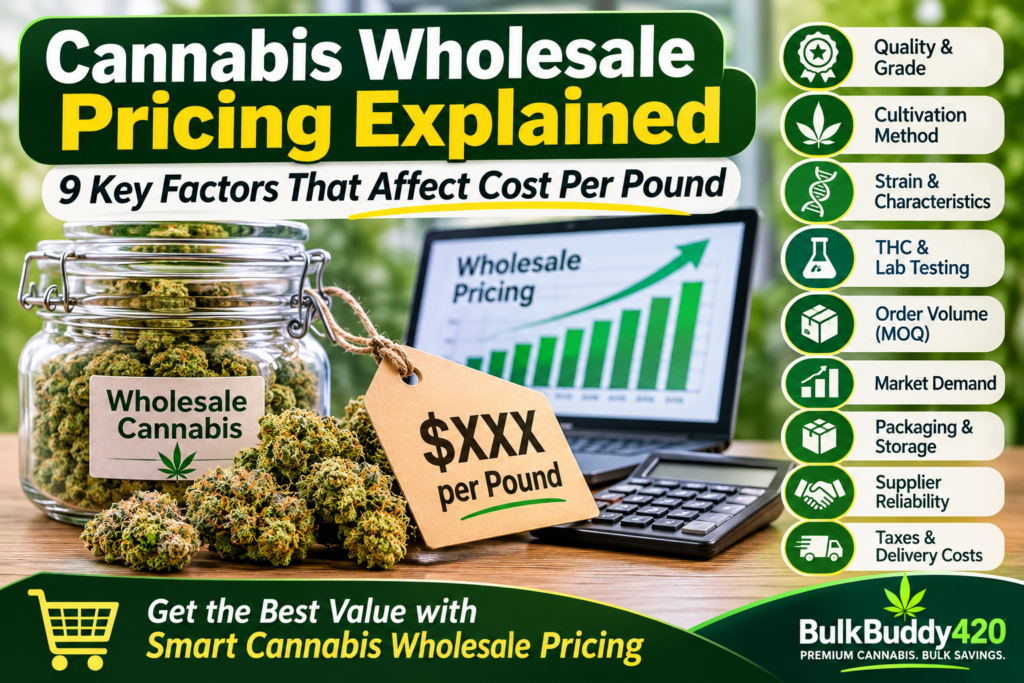
Cannabis Wholesale Pricing Explained: 9 Key Factors That Affect Cost Per Pound
Understanding cannabis wholesale pricing helps eligible businesses compare supplier quotations, evaluate product specifications, and plan inventory costs. Prices can vary depending on product quality, cultivation methods, testing requirements, order volume, market conditions, and additional transaction expenses. This guide explains the main factors that influence wholesale costs and how to evaluate supplier quotations before making business decisions.
When researching cannabis wholesale pricing, it is important to look beyond the quoted amount. A competitive price does not automatically guarantee product quality, reliable documentation, or a legitimate supplier. Always ensure that purchases and transfers comply with the cannabis laws and licensing requirements applicable to your business and jurisdiction.
What Is Cannabis Wholesale Pricing?
Cannabis wholesale pricing refers to the amount a legally eligible business pays when purchasing cannabis products through an authorized business-to-business supply channel. Suppliers may quote prices per pound, kilogram, unit, package, or another agreed measurement.
There is no single universal wholesale rate. Location, product category, supply conditions, production expenses, and regulatory requirements can all influence a supplier’s quotation. Understanding these differences helps businesses evaluate cannabis wholesale pricing more accurately.
A low headline price may exclude packaging, taxes, transportation, or other transaction expenses. Always confirm exactly what a supplier’s quotation includes before comparing it with another offer.
1. Cannabis Flower Quality and Grade
Product quality is one of the major considerations influencing cannabis wholesale pricing. Cannabis flower can differ in structure, density, trim quality, freshness, moisture condition, aroma, and batch consistency. These characteristics can influence how a product is described and commercially valued.
Important quality considerations include:
- Bud structure, density, and overall appearance.
- Trim quality and visible plant material.
- Freshness and documented storage conditions.
- Aroma and available terpene information.
- Consistency between production batches.
- Applicable laboratory testing and compliance records.
Grade labels such as AA, AAA, or AAAA are not necessarily standardized across suppliers. Buyers should request written product specifications and batch information rather than assuming that a grade label guarantees a particular quality level.
2. Indoor, Outdoor, and Greenhouse Cultivation
Cultivation methods can influence production expenses and contribute to differences in cannabis wholesale pricing. Indoor, outdoor, and greenhouse operations have different growing conditions, infrastructure requirements, and operating costs.
Indoor-grown cannabis
Indoor cultivation uses controlled environments and specialized equipment. Lighting, ventilation, climate control, electricity, and labor can contribute to production expenses.
Outdoor-grown cannabis
Outdoor cultivation relies more heavily on natural sunlight and seasonal conditions. Production expenses may differ, while weather exposure and environmental factors can affect crop consistency.
Greenhouse-grown cannabis
Greenhouse cultivation combines natural sunlight with varying levels of environmental control. Its production costs depend on the facility, growing techniques, and operating requirements.
No cultivation method automatically guarantees superior quality. Compare the actual product specifications, documented condition, batch consistency, and applicable testing results.
3. Strain and Product Characteristics
Genetics, product availability, production scale, cannabinoid profile, terpene profile, and market demand can all contribute to differences in cannabis wholesale pricing.
A popular strain may receive a different quotation because of demand or limited availability. However, a familiar strain name does not guarantee a particular quality level or product specification.
When comparing products, consider:
- Genetic and strain information.
- Available cannabinoid and terpene profiles.
- Product appearance and condition.
- Batch consistency and availability.
- Relevant laboratory documentation.
Comparing documented product characteristics is more useful than relying on strain popularity or marketing descriptions alone.
4. THC Content and Laboratory Testing
Reported cannabinoid information may form part of a product’s commercial specification, but THC percentage should not be treated as the only measure of quality or value. When evaluating cannabis wholesale pricing, review the Certificate of Analysis (COA), batch identifier, testing date, laboratory details, and results for tests required in the relevant jurisdiction.
Laboratory testing may cover cannabinoid content, pesticides, heavy metals, microbial impurities, residual solvents, and other applicable safety requirements. Testing standards vary by jurisdiction.
For a California-specific overview, consult the California Department of Cannabis Control’s official cannabis testing guidance. It explains testing and COA reporting requirements for California-regulated cannabis goods. It is not a universal rulebook for other markets.
A COA should correspond to the actual batch being evaluated. A report for a different product or batch does not establish the compliance status of the goods in a quotation. Higher reported THC does not automatically mean fresher, safer, or better overall product quality.
5. Order Volume and Minimum Order Requirements
Order size may affect supplier terms and the way cannabis wholesale pricing is quoted. Some suppliers establish minimum order quantities (MOQs), while others provide quotations based on quantity, packaging, product availability, and transaction requirements.
Before evaluating a quotation, confirm:
- The supplier’s minimum order quantity.
- Whether the measurement is pounds, kilograms, or individual units.
- Whether the quotation covers one product or multiple products.
- Whether packaging and handling are included.
- Any conditions attached to the quoted price.
A larger order does not automatically provide better value. Businesses should consider the total financial commitment, storage needs, product documentation, and legal obligations before accepting volume-based commercial terms.
6. Supply, Demand, and Market Conditions
Market conditions can influence cannabis wholesale pricing over time. Product availability, seasonal production, regional demand, competition, regulatory changes, and operating expenses may all contribute to differences in supplier quotations.
A limited supply of a particular product may affect its quoted price. Changes in production levels or market demand may also influence commercial offers.
Compare quotations within the same relevant market and time period. Historical quotations are not guarantees of current prices, and markets operating under different regulations should not be treated as directly equivalent.
7. Packaging, Storage, and Product Handling
Packaging and handling arrangements can contribute to cannabis wholesale pricing. Depending on the product and jurisdiction, requirements may cover approved packaging, product labels, batch identification, traceability, secure storage, and handling records.
Ask suppliers whether packaging, storage, and handling are included in the quotation or charged separately. Poor storage conditions can also affect product condition, so request clear information about how goods are handled and documented.
8. Supplier Reliability and Documentation
A competitive quotation is useful only when the supplier and proposed transaction can be verified. Evaluating cannabis wholesale pricing should therefore include checking the supplier’s business identity, relevant licence, authorized activities, product records, and applicable testing documents.
Important supplier verification questions include:
- Does the supplier hold the authorization required for the proposed activity?
- Does the licence match the business and operating location?
- Are product and batch records available?
- Can applicable laboratory reports be verified?
- Do payment instructions match the contracting business?
- Are delivery arrangements lawful for the route and destination?
Verify information directly with the relevant regulator wherever possible. Do not rely only on screenshots, promotional claims, or documents that cannot be independently checked.
9. Taxes, Transportation, and Additional Transaction Costs
The product figure alone may not represent the complete cost of a transaction. A full assessment of cannabis wholesale pricing should account for applicable taxes, regulatory fees, authorized transportation, packaging, handling, insurance where applicable, storage, and administrative expenses.
Ask each supplier for an itemized quotation and calculate the total cost using the same assumptions. A lower product price may become more expensive once additional charges are included.
How to Compare Cannabis Wholesale Supplier Quotations
Comparing supplier quotations is easier when each business provides information in a consistent format. Use the following criteria when evaluating cannabis wholesale pricing and comparing similar products.
| Comparison factor | What to check |
|---|---|
| Product type | Flower, concentrates, or another product category |
| Quality specifications | Written grade description, condition, and consistency |
| Cultivation method | Indoor, outdoor, or greenhouse, where applicable |
| Laboratory documentation | COA, batch number, and relevant test results |
| Quantity and MOQ | Measurement unit and minimum order |
| Packaging and delivery | Included services and authorized arrangements |
| Additional charges | Taxes, fees, handling, and storage |
| Supplier credentials | Business identity and relevant licences |
The strongest comparison is not simply the lowest figure. It is a transparent quotation for a clearly specified product from a verifiable supplier, with all applicable costs and responsibilities identified.
Common Mistakes When Evaluating Wholesale Prices
Choosing the cheapest quotation automatically
A low price does not establish product quality, supplier reliability, or legal compliance. Review the specifications and supporting records before drawing conclusions about value.
Comparing different product grades
Quotations are not directly comparable when products have different specifications, conditions, or batch documentation.
Ignoring testing records
Where testing is required, check that the report is authentic, relevant to the batch, and issued by an appropriately authorized laboratory.
Overlooking additional costs
Transportation, taxes, packaging, and handling can change the final transaction cost. Request an itemized quotation before making comparisons.
Failing to verify the supplier
Check business identity, relevant licensing, authorized activities, and transaction documents before making a commitment.
Frequently Asked Questions
What determines cannabis wholesale pricing?
Cannabis wholesale pricing may be influenced by product quality, cultivation method, strain characteristics, cannabinoid profile, testing, order volume, supply and demand, packaging, and additional transaction costs.
How is cannabis wholesale pricing calculated?
Cannabis wholesale pricing may be quoted per pound, kilogram, unit, or package. Confirm the measurement, quantity, included services, and additional charges before comparing supplier quotations.
Why do wholesale prices vary between suppliers?
Suppliers may have different production costs, product specifications, availability, operating expenses, and commercial terms. Local regulations and market conditions can also contribute to differences.
Does higher THC mean a higher-quality product?
Not necessarily. THC is only one part of a product’s cannabinoid profile. Consider freshness, condition, terpene information, and applicable laboratory results as well.
Does buying a larger quantity always reduce the price?
Not always. Some suppliers offer volume-based terms, but the final quotation depends on product availability, supplier conditions, packaging, and other transaction costs.
What should I check before accepting a wholesale quotation?
Verify the supplier’s relevant licences, product specifications, batch documentation, laboratory reports, payment terms, delivery arrangements, and additional charges. Confirm that the transaction is permitted under applicable regulations.
Final Thoughts on Cannabis Wholesale Pricing
Understanding cannabis wholesale pricing means looking beyond the quoted amount. Product quality, cultivation methods, testing, order volume, supplier credentials, and additional transaction expenses all contribute to the overall value of a commercial offer.
Eligible business buyers should compare equivalent products, request transparent documentation, verify suppliers independently, and calculate the complete transaction cost before making a decision. Explore available product categories through the BulkBuddy420 shop, and make purchasing decisions in accordance with applicable laws and verified business documentation.