How to Choose Cannabis by THC Percentage: What 10%, 20%, 30%+ Really Means
Understanding how to choose cannabis by THC percentage can help you interpret product labels and compare cannabis flower more accurately. THC percentages such as 10%, 20%, and 30%+ describe the stated concentration of tetrahydrocannabinol, the primary intoxicating compound in cannabis. However, a higher percentage does not automatically mean better quality, greater purity, or a more suitable product.
This guide explains how THC percentages work, what different numbers represent, and which other factors matter when evaluating cannabis products. Learning how to choose cannabis by THC percentage involves understanding potency, cannabinoid profiles, product testing, and potential health risks rather than focusing on a single number.
What Does THC Percentage Mean?
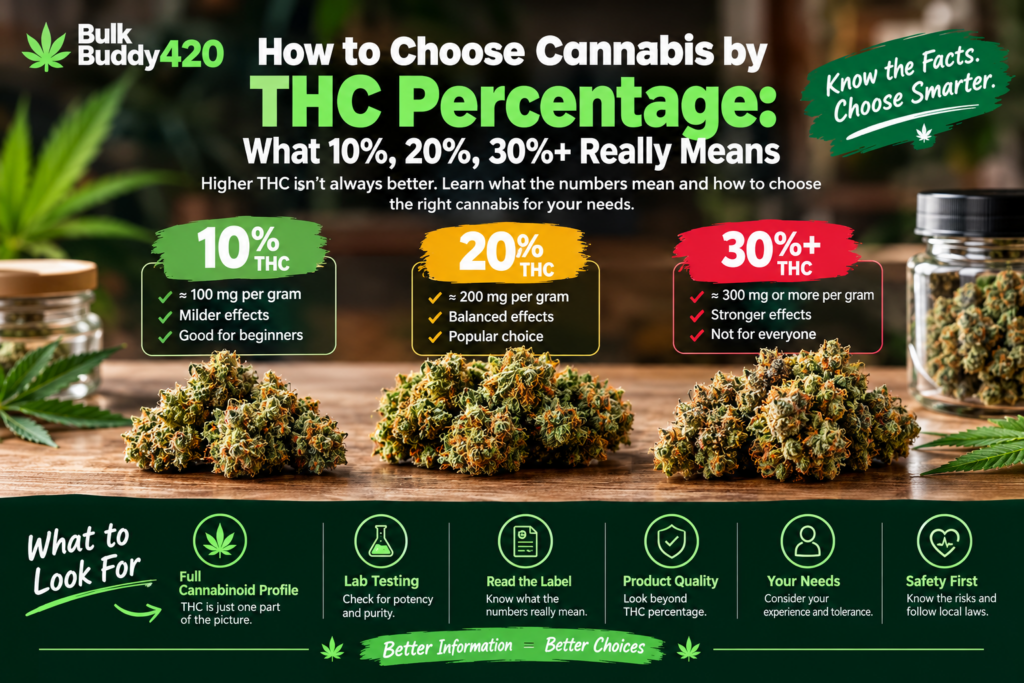
THC percentage generally represents the proportion of a product’s weight attributed to THC, according to the measurement reported on its label. For example, flower labeled 10% THC contains approximately 100 milligrams of THC per gram of flower, while flower labeled 20% contains approximately 200 milligrams per gram.
These figures describe the stated THC content in the plant material, not the amount that necessarily enters the bloodstream. Actual exposure depends on the product, how it is consumed, and individual factors.
When learning how to choose cannabis by THC percentage, remember that labels may use different measurements, and testing methods can vary. Check whether a product reports THC or total THC and review available laboratory information before drawing conclusions.
What Does 10% THC Mean?
Cannabis flower labeled 10% THC contains approximately 100 milligrams of THC per gram of flower. This is a lower stated concentration than flower labeled 20% or 30% THC.
A lower percentage does not guarantee a predictable or risk-free experience. Individual sensitivity, the amount consumed, and other characteristics can influence the effects.
What to consider with 10% THC flower
- Review the stated THC percentage and other available cannabinoid information.
- Look for reliable laboratory testing where available.
- Remember that lower THC content does not eliminate impairment or other potential risks.
- Evaluate product condition and labeling rather than relying on potency alone.
Understanding how to choose cannabis by THC percentage means treating 10% as a concentration reference, not a guarantee of safety or suitability.
What Does 20% THC Mean?
Flower labeled 20% THC contains approximately 200 milligrams of THC per gram. Assuming comparable and accurate measurements, that represents twice the stated THC concentration of flower labeled 10%.
However, twice the concentration does not necessarily produce twice the subjective effects. Cannabis affects people differently, and the relationship between THC content and an individual’s experience is complex.
When evaluating 20% THC flower, look beyond the headline percentage. Review the cannabinoid information, available test results, product condition, and potential for impairment. A percentage alone cannot establish freshness, purity, or overall quality.
A practical approach to how to choose cannabis by THC percentage is to compare verified product information instead of assuming that a higher number represents a better product.
What Does 30%+ THC Mean?
Flower labeled 30% THC contains approximately 300 milligrams of THC per gram of flower. Products labeled 30%+ therefore have a high stated THC concentration compared with products labeled 10% or 20%.
High THC exposure can increase the risk of unwanted effects, including anxiety, panic, confusion, impaired coordination, and a rapid heartbeat. High potency should not be confused with high quality.
What to check with high-THC products
- Look for credible testing information and clear cannabinoid labeling.
- Check whether the stated percentage is supported by reliable product documentation.
- Be cautious of promotional claims that emphasize extreme potency without evidence.
- Consider the potential health risks associated with high THC exposure.
When researching how to choose cannabis by THC percentage, remember that 30%+ THC does not prove that flower is fresher, cleaner, or better cultivated than a lower-THC alternative.
10% vs 20% vs 30%+ THC: Comparison Table
The following table shows the approximate THC content represented by different percentages in one gram of flower.
| Stated THC percentage | Approximate THC per gram | What the figure tells you |
|---|---|---|
| 10% | 100 mg | Lower stated concentration than the other examples |
| 20% | 200 mg | Twice the stated concentration of 10% flower |
| 30%+ | 300 mg or more | High stated THC concentration |
These calculations describe THC content by weight, not the amount absorbed by the body. Product labeling, laboratory methods, and actual composition can vary.
This is why how to choose cannabis by THC percentage should be approached as a product-labeling question rather than a simple ranking from weakest to best.
7 Things to Check Before Comparing THC Percentages
1. Review the full cannabinoid profile
THC is only one of the compounds found in cannabis. Some products also contain CBD and other cannabinoids. Reviewing the available cannabinoid profile gives you more information than looking at THC percentage alone.
2. Look for independent laboratory testing
Where available, laboratory reports can help verify cannabinoid content and screen for contaminants such as pesticides, heavy metals, microbes, or residual solvents where relevant. Check that the information corresponds to the product being sold.
3. Separate potency from quality
A high THC percentage does not prove that flower has been properly cultivated, dried, cured, or stored. Product quality involves several factors, including condition, labeling accuracy, and available testing information.
4. Read the label carefully
Check whether the label reports THC or total THC and understand the units used. For edibles, oils, and concentrates, pay attention to the amount per serving and the total amount in the package. These measurements are not directly interchangeable with flower percentages.
5. Consider the product type
Flower, gummies, vapes, and concentrates have different characteristics. Inhaled products may produce effects more quickly, while edibles can have delayed and prolonged effects. Concentrates may contain particularly high levels of THC.
6. Question extreme potency claims
Be cautious when a seller promotes unusually high THC levels without clear supporting information. Product names, appearance, and advertising do not independently establish potency or purity.
7. Account for health and legal considerations
Cannabis can affect memory, attention, coordination, and judgment. Laws differ by location, and some people may face greater health risks. Avoid driving while impaired, store cannabis securely away from children and pets, and seek medical advice if you have concerns about health conditions or medication interactions.
Following these checks makes how to choose cannabis by THC percentage a more informed comparison process instead of a decision based only on the highest number on a label.
Does Higher THC Mean Better Cannabis?
No. THC percentage measures concentration, not overall product quality. A high-THC product may still have poor labeling, inadequate testing, or storage problems. A lower-THC product is not automatically superior either.
Compare the full cannabinoid profile, product condition, testing information, and seller transparency. Avoid treating THC percentage as a score that determines whether one product is universally better than another.
The key to how to choose cannabis by THC percentage is understanding what the number tells you and what it leaves out. Potency is one factor to evaluate alongside other verifiable product details.
How THC Percentages Differ Across Cannabis Products
THC percentages are commonly used to describe flower and some concentrates, while edible products often list THC in milligrams. These measurements should not be compared as though they mean the same thing.
For example, a gummy label may state the amount of THC per serving or per package. A flower label typically reports THC as a proportion of its weight. The body also processes inhaled and ingested cannabis differently.
Edibles can have delayed effects that last longer, while inhaled products can produce effects more quickly. Concentrates may have high THC concentrations, which can increase the risk of unwanted effects.
Anyone researching how to choose cannabis by THC percentage should compare products within the appropriate category and avoid assuming that a percentage on flower can be directly compared with milligrams on an edible.
Common Mistakes When Reading THC Labels
- Assuming higher is always better: Potency does not establish freshness, purity, or suitability.
- Ignoring measurement units: Percentages and milligrams describe different measurements.
- Overlooking laboratory information: Clear testing data can help verify label claims where available.
- Trusting marketing alone: Promotional language is not proof of quality or health benefits.
- Forgetting product-specific risks: Edibles, inhaled products, and concentrates have different considerations.
A careful how to choose cannabis by THC percentage approach helps prevent these mistakes by combining label reading with product transparency and health awareness.
Cannabis Safety and Health Information
THC can impair attention, memory, reaction time, coordination, and judgment. It may also cause anxiety, panic, confusion, or other adverse effects. Risks can depend on potency, frequency of use, age, health, and individual susceptibility.
- Do not drive or operate machinery while impaired.
- Avoid combining cannabis with alcohol or other intoxicating substances.
- Keep cannabis products securely stored away from children and pets.
- Avoid cannabis during pregnancy or breastfeeding.
- People with certain medical conditions or a personal or family history of psychosis should be especially cautious and seek qualified medical guidance.
- Seek urgent medical help for severe symptoms such as difficulty breathing, loss of consciousness, or serious confusion.
For more information, read the Centers for Disease Control and Prevention’s guide to cannabis health effects. This resource explains potential health risks and other important considerations.
Understanding how to choose cannabis by THC percentage does not replace professional medical advice. No THC percentage guarantees a safe experience, and people should consider health risks and local laws before making decisions about cannabis.
Frequently Asked Questions
Is 10% THC considered low?
It is a lower stated THC concentration than 20% or 30% flower, but the percentage alone cannot predict an individual’s experience. Sensitivity, amount consumed, and other factors influence effects.
Is 20% THC twice as strong as 10% THC?
It represents approximately twice the stated THC concentration by weight when the measurements are comparable and accurate. It does not mean the subjective effects will be exactly twice as strong.
Is 30% THC better than 20% THC?
Not necessarily. A higher percentage does not establish better quality, purity, freshness, or suitability. Higher THC exposure can also increase the risk of unwanted effects.
Does THC percentage tell me how fresh cannabis is?
No. THC percentage does not establish freshness. Product condition, storage, packaging, and reliable testing information are separate considerations.
Can I compare flower percentages with gummy THC amounts?
Not directly. Flower percentages describe THC concentration relative to weight, while edible labels commonly report milligrams per serving or package. The units and product formats differ.
Final Thoughts
Learning how to choose cannabis by THC percentage helps you understand what product labels can—and cannot—tell you. Figures such as 10%, 20%, and 30%+ describe stated THC concentration, but they do not independently establish quality, purity, freshness, or individual effects.
Prioritize accurate labeling, credible testing where available, transparent product information, health considerations, and compliance with local regulations. Do not assume the highest THC percentage is automatically the best choice.
For general product-category browsing, visit the Bulk Buddy420 shop. Make sure any purchase complies with the laws that apply to your location.