
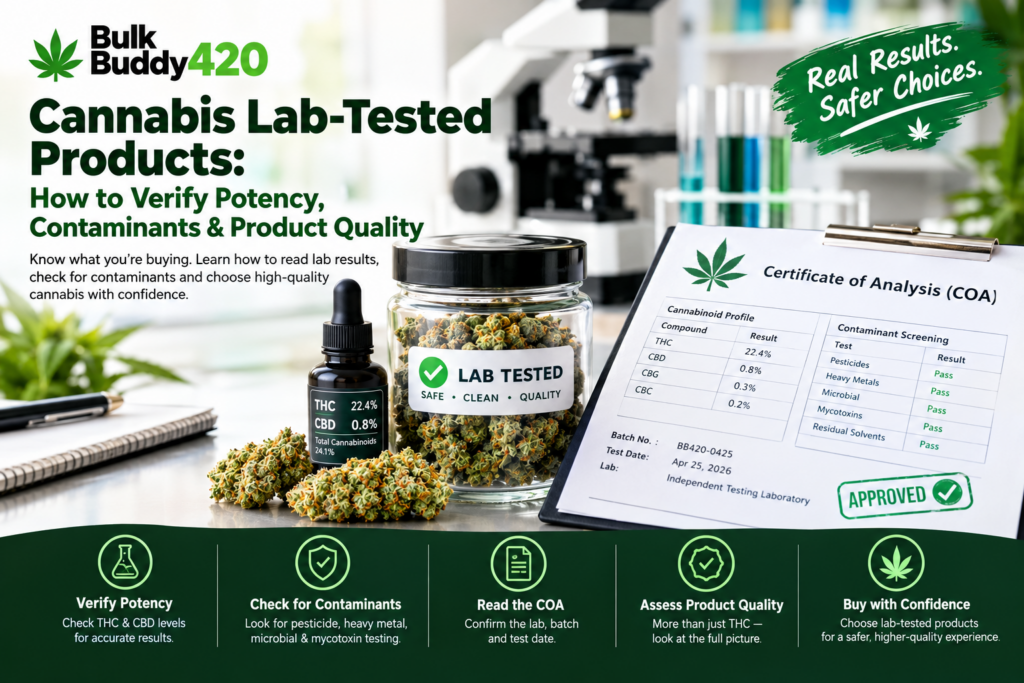
Cannabis Lab-Tested Products: How to Verify Potency, Contaminants & Product Quality
Understanding cannabis lab-tested products can help consumers make more informed decisions about product labeling, cannabinoid potency, and potential contaminants. Laboratory reports provide useful information about what was tested, the results obtained, and whether the sample met the applicable testing standards.
However, the phrase “lab-tested” alone does not guarantee that a product is completely safe or that every possible contaminant has been checked. Knowing how to read a Certificate of Analysis (COA), compare reported THC and CBD levels, and verify batch information can help you evaluate product quality more carefully.
What Are Cannabis Lab-Tested Products?
Cannabis lab-tested products are products that have been analyzed by a laboratory for specific characteristics, such as cannabinoid content or the presence of selected contaminants. Depending on the product and applicable regulations, testing may cover potency, pesticides, heavy metals, microbial impurities, mycotoxins, and residual solvents.
Testing requirements vary by jurisdiction and product type. Before relying on a test report, check which tests were performed, which laboratory conducted them, and whether the report applies to the exact product and batch you are considering.
1. Check the Certificate of Analysis (COA)
A Certificate of Analysis, commonly called a COA, is a laboratory report that records analytical results for a particular sample. When reviewing cannabis lab-tested products, the COA is one of the most useful documents for understanding the reported potency and testing coverage.
A COA may include:
- The laboratory’s name and identifying information.
- The product name, sample identification, and batch or lot number.
- The date the sample was received or tested.
- Reported THC, CBD, and other cannabinoid levels.
- Results for contaminants included in the testing panel.
- Pass, fail, or other result indicators, where applicable.
Do not rely on a report simply because it looks official. Confirm that its product details and batch number match the item being evaluated. A report for a different batch may not accurately describe the product in front of you.
2. Verify THC and CBD Potency
Potency testing measures the amount or concentration of cannabinoids in a sample. THC and CBD are commonly reported, although some laboratory reports also include other cannabinoids and additional profile information.
When comparing cannabis lab-tested products, check whether the label and COA use the same units. Flower may show cannabinoid percentages, while edibles and other products may report milligrams per serving or package. These measurements are not directly interchangeable without considering the product’s weight and serving information.
Remember that a higher THC percentage does not automatically mean better quality. Potency is only one part of a product’s overall profile, and reported results should be considered alongside product type, labeling accuracy, and other available quality information.
3. Look for Pesticide Testing
Pesticide testing can identify certain pesticide residues that may remain from cultivation or handling. The substances tested and the limits used to evaluate results depend on the applicable testing standards.
When checking cannabis lab-tested products, look for a pesticide section in the COA. Review the result for each substance listed rather than assuming that a general “tested” label means every pesticide was included.
If the report does not include pesticide screening, you cannot conclude from that report alone that the sample was tested for pesticides.
4. Review Heavy Metal Results
Heavy metals such as lead, arsenic, cadmium, and mercury may be included in cannabis testing panels. These substances can enter products through environmental exposure, growing conditions, or processing equipment.
Check whether the COA lists the relevant metals, provides results, and indicates how those results compare with the applicable limits. The absence of a listed result does not establish that the substance was tested for or absent from the sample.
5. Check for Mold, Bacteria, and Mycotoxins
Microbial testing may screen for certain bacteria, yeast, molds, or other microorganisms. Some testing panels also include mycotoxins, which are harmful substances that can be produced by particular fungi.
These tests matter because a product’s appearance, aroma, or packaging cannot reliably establish its microbial status. When reviewing cannabis lab-tested products, check the COA for the specific microbial and mycotoxin tests performed and the results reported.
A passing result applies to the sample and tests described in the report. It is not a universal guarantee that every unit in a batch is free from every possible contaminant.
6. Check Residual Solvent Testing for Concentrates
Some cannabis concentrates are produced using solvents or other processing chemicals. Depending on the manufacturing method and applicable requirements, laboratory testing may assess residual solvents in the finished product.
If you are evaluating a concentrate, review whether residual solvent testing appears in the COA. Look for the individual substances tested, the reported results, and any applicable pass or fail indicators.
Do not assume that every concentrate uses the same production method or that every COA includes the same solvent panel. The report should make clear which tests were actually performed.
7. Confirm the Laboratory and Report Details
A useful laboratory report should identify the laboratory and provide enough information to connect the results to the tested sample. Where possible, check whether the laboratory is appropriately licensed, accredited, or recognized under the relevant local regulatory system.
Look for consistent product identifiers, batch information, testing dates, and clearly presented results. If a report appears incomplete, the batch details do not match, or the results cannot be verified, ask the seller or responsible business for clarification before relying on it.
8. Understand What a Lab Report Cannot Prove
Even reliable cannabis lab-tested products reports have limits. A COA describes the sample analyzed and the tests performed under the stated laboratory methods. It does not automatically prove that every unit is identical, that untested contaminants are absent, or that a product will produce a particular effect.
Testing also cannot replace appropriate storage, accurate labeling, responsible use, or compliance with local law. Treat a COA as one important source of evidence rather than a blanket guarantee of safety or quality.
Quick Checklist for Evaluating Cannabis Lab-Tested Products
- Confirm that the COA matches the exact product and batch.
- Check the laboratory’s identity and available credentials.
- Compare the reported THC and CBD values with the product label.
- Review pesticide and heavy metal screening where applicable.
- Check microbial and mycotoxin results where applicable.
- Review residual solvent testing for relevant concentrates.
- Read individual results instead of relying only on a “lab-tested” claim.
- Check the test date and any available sample identifiers.
- Ask for clarification if results are missing, unclear, or inconsistent.
- Remember that testing covers only the sample and tests described in the report.
Where to Learn More About Cannabis Testing
For additional information, read the California Department of Cannabis Control’s guide to cannabis testing laboratories. It explains how testing laboratories report cannabinoid levels and screen for selected contaminants. Testing requirements vary by jurisdiction, so consult the relevant regulator for the rules that apply to your location.
Frequently Asked Questions
What does lab-tested mean for cannabis?
It means a sample has undergone laboratory analysis for specified characteristics. The exact tests and standards depend on the product and the applicable regulatory requirements.
What is a cannabis COA?
A Certificate of Analysis is a laboratory report that records results for a tested sample. It may include cannabinoid potency and results for specific contaminants.
Does a high THC percentage mean better quality?
No. THC percentage measures one aspect of cannabinoid potency. It does not independently establish overall product quality, purity, or suitability for an individual.
Does a COA guarantee that a product is completely safe?
No. A COA documents the sample and tests described in the report. It cannot guarantee the absence of every possible contaminant or prove that every unit in a batch is identical.
What should I do if a seller cannot provide a matching COA?
Ask for documentation that identifies the exact product and batch. If the report cannot be verified or important information is missing, do not treat the product’s testing claims as confirmed.
Final Thoughts
Learning how to evaluate cannabis lab-tested products can help you interpret potency labels, understand contaminant screening, and recognize the value and limitations of laboratory reports. The most useful approach is to verify the batch details, read the individual test results, and avoid treating “lab-tested” as an unconditional safety guarantee.
Explore the Bulk Buddy420 shop for product information, and review relevant product documentation when available. Always follow the laws that apply to your location and make informed decisions based on reliable information.