How to Tell if Cannabis Is Fresh: 12 Signs of Fresh vs Old Weed Before You Buy
Learning how to tell if cannabis is fresh can help you make more informed decisions before purchasing cannabis flower. Aroma, color, texture, trichome appearance, packaging, and storage conditions can all provide useful clues about how well a product has been preserved. However, no single sign can guarantee freshness, potency, or safety.
If you are comparing products before buying, understanding how to tell if cannabis is fresh can help you recognize potential quality concerns and ask better questions about a product’s history. This guide covers 12 practical signs of fresh versus old weed, the warning signs to avoid, and the information worth checking before you buy.
Why Cannabis Freshness Matters
Cannabis flower can change over time because of exposure to oxygen, light, heat, and unsuitable humidity. These conditions may affect its aroma, texture, appearance, and chemical composition. Proper curing, protective packaging, and suitable storage can help preserve its characteristics.
Understanding how to tell if cannabis is fresh involves more than choosing buds that look attractive. A product may have a strong aroma and appealing appearance while still having problems that cannot be detected through a visual inspection. Product history, traceability, and available laboratory documentation also matter.
When reviewing products at Bulk Buddy420’s shop, consider the available product information alongside the signs explained below.
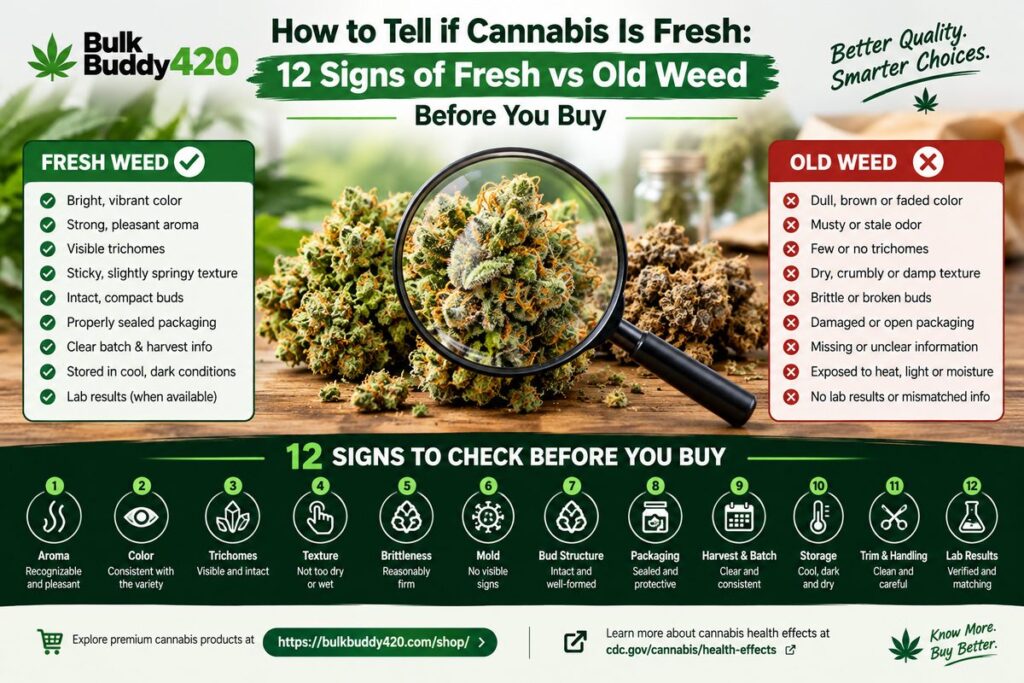
12 Signs of Fresh vs Old Weed Before You Buy
1. Check the Aroma
Aroma is one of the first characteristics people notice when evaluating cannabis flower. Depending on the variety, its scent may be earthy, citrusy, pine-like, floral, fruity, or pungent. Changes in aroma may occur as aromatic compounds degrade during storage.
When considering how to tell if cannabis is fresh, pay attention to unusual smells. A musty, mold-like, or damp organic odor can be a warning sign that the product has been exposed to unsuitable conditions.
- Potentially positive sign: A recognizable aroma consistent with the variety and product description.
- Warning sign: A musty, mold-like, or unusually stale odor.
A strong smell does not automatically prove that cannabis is fresh, potent, or free from contaminants. Natural aroma also varies between varieties.
2. Examine the Color
Cannabis flower naturally varies in color. Green shades are common, while some varieties may display purple, orange, or reddish features. Genetics, growing conditions, curing, and storage can all influence appearance.
One consideration when learning how to tell if cannabis is fresh is whether the color appears consistent with the product description. Extensive browning, fading, or unexplained dark patches may justify closer inspection, although color alone cannot establish the product’s age.
- Potentially positive sign: Color that looks consistent with the variety.
- Warning sign: Extensive unexplained discoloration or suspicious dark patches.
Do not assume that purple buds are automatically better or that every green bud is fresh. Evaluate the overall condition rather than judging by color alone.
3. Look at the Trichomes
Trichomes are tiny structures on cannabis flower that can appear crystal-like under suitable lighting. They contain many of the plant’s cannabinoids and aromatic compounds. Their appearance varies by variety, maturity, and handling.
When assessing how to tell if cannabis is fresh, look for visible trichome coverage consistent with the flower’s characteristics. Extensive damage or signs of rough handling may indicate that the product has lost some of its delicate surface structures.
Trichome appearance cannot confirm an exact THC percentage. Laboratory testing is a more appropriate way to evaluate reported cannabinoid potency.
4. Assess the Texture
Texture can offer clues about the condition of cannabis flower. Properly cured flower generally should not feel wet or slimy, and it should not be so excessively dry that it disintegrates with minimal handling. Different varieties naturally vary in density and texture.
A useful part of understanding how to tell if cannabis is fresh is recognizing the difference between reasonably well-preserved flower and material that appears severely dried out or damp.
- Potentially positive sign: Flower that appears intact and is neither visibly wet nor extremely brittle.
- Warning sign: Soggy, slimy, or unusually fragile flower.
Avoid repeatedly squeezing buds to test their texture. Excessive handling can damage the flower and remove trichomes.
5. Check for Excessive Brittleness
Flower that has lost too much moisture may become fragile and break apart easily. Severe brittleness can indicate excessive drying, prolonged exposure to air, or unsuitable storage conditions.
However, dryness does not automatically mean that cannabis is old. Curing and storage methods can also influence texture. When deciding how to tell if cannabis is fresh, consider brittleness together with aroma, appearance, packaging, and available product history.
- Potentially positive sign: Buds that remain reasonably intact.
- Warning sign: Flower that crumbles excessively or has become powdery.
6. Inspect for Mold or Unusual Growth
Visible mold or suspicious growth is an important warning sign. Look for fuzzy patches, unusual web-like material, or unexplained powdery areas that may indicate contamination. Natural trichomes can look crystal-like, so visual inspection is not always conclusive.
Knowing how to tell if cannabis is fresh also means knowing when not to buy or use a product. If flower appears moldy or smells strongly musty, avoid using it. Do not try to determine whether suspicious flower is safe by tasting or smoking it.
- Potentially positive sign: No visible signs of suspicious growth, while recognizing that this does not prove the absence of contaminants.
- Warning sign: Fuzzy growth, unexplained patches, or a strong mold-like odor.
Laboratory testing may be needed to identify certain contaminants. People with respiratory conditions or allergies may be particularly vulnerable to exposure, but suspected mold should be avoided by everyone.
7. Consider the Bud Structure
Cannabis varieties naturally differ in size, shape, and density. Some produce compact buds, while others have a looser or airier structure. Neither structure alone establishes freshness or overall quality.
As part of evaluating how to tell if cannabis is fresh, check whether the flower appears reasonably intact and consistent with the product description. Extensive fragmentation, crushed material, or widespread deterioration may indicate poor handling or storage.
- Potentially positive sign: Buds that remain reasonably intact.
- Warning sign: Excessive crumbling, crushing, or deterioration.
Do not assume that dense buds are always fresher than airy buds. Genetics and cultivation conditions can produce different structures.
8. Inspect the Packaging
Protective packaging helps limit exposure to environmental conditions that can affect cannabis flower. Packaging designed to protect the product can help preserve its characteristics during storage and transportation.
When considering how to tell if cannabis is fresh, inspect the container or package where possible. Look for intact seals, clear product identification, and storage information. Damaged packaging or an unexplained broken seal deserves further attention.
- Potentially positive sign: Intact packaging designed to protect the flower.
- Warning sign: Damaged seals, compromised containers, or signs of unsuitable storage.
Sealed packaging is not a guarantee of freshness. A product can still be old, contaminated, or poorly stored even when its container appears intact.
9. Check Harvest, Packaging, and Batch Information
Product dates and batch details can help you understand the history of cannabis flower. Depending on local regulations, labels may include a harvest date, packaging date, batch number, or other traceability information.
Learning how to tell if cannabis is fresh includes understanding that the packaging date and harvest date are not necessarily the same. A recently packaged product may have been harvested earlier, while a product with an older harvest date may have been stored carefully.
- Potentially positive sign: Clear, consistent product dates and traceable batch information.
- Warning sign: Conflicting details or missing information that should be available under applicable rules.
Ask the seller for clarification if important information is unclear. Labeling requirements vary by jurisdiction.
10. Ask About Storage Conditions
Storage can influence how well cannabis flower retains its aroma, texture, and other characteristics. Excessive heat, direct light, oxygen exposure, and unsuitable humidity may contribute to deterioration over time.
One practical way to assess how to tell if cannabis is fresh is to ask whether the product has been stored in a suitable environment and protected from excessive light, heat, and moisture.
- Potentially positive sign: Sensible storage practices and protective packaging.
- Warning sign: Prolonged exposure to direct sunlight, excessive heat, moisture, or open air.
Good storage can help preserve product quality, but it cannot reverse deterioration that has already occurred.
11. Evaluate Trim and Handling
The trim and appearance of cannabis flower vary depending on the producer’s methods and the product itself. A neat trim may improve appearance, but it does not prove that the flower is fresh or safe.
When assessing how to tell if cannabis is fresh, look for excessive damage, widespread fragmentation, or unusually large amounts of loose material that do not match the product description.
- Potentially positive sign: Flower that appears reasonably intact and appropriately handled.
- Warning sign: Extensive damage, excessive debris, or signs of careless storage.
Do not judge quality solely by appearance. Product documentation, storage information, and appropriate testing can provide additional context.
12. Review Available Laboratory Results
Visual inspection and smell cannot confirm every aspect of cannabis quality. Where available, laboratory results may provide information about cannabinoid content and selected contaminants.
A Certificate of Analysis (COA) should be checked against the product and batch being evaluated. Review the reported THC and CBD levels, the testing date, the laboratory details, and the contaminants included in the testing panel.
When deciding how to tell if cannabis is fresh, remember that a COA does not necessarily measure freshness directly. It documents the sample and tests described in the report, and it cannot guarantee that every unit is identical or that every possible contaminant has been tested.
- Potentially positive sign: Clear, verifiable product information and relevant testing documentation.
- Warning sign: Unsupported testing claims, mismatched batch details, or incomplete documentation.
Fresh Weed vs Old Weed: Quick Comparison
| Feature | Potentially Well-Preserved Flower | Potential Warning Sign |
|---|---|---|
| Aroma | Recognizable variety-specific scent | Musty, mold-like, or unusually stale odor |
| Color | Consistent with the variety | Extensive unexplained discoloration |
| Trichomes | Visible structures consistent with the flower | Extensive damage or loss from handling |
| Texture | Not excessively wet or brittle | Damp, slimy, or extremely brittle |
| Bud condition | Reasonably intact | Excessively crushed or fragmented |
| Packaging | Intact and protective | Damaged or compromised seal |
| Product information | Clear and consistent details | Missing or conflicting information |
| Storage | Protected from excessive heat, light, and moisture | Prolonged exposure to unsuitable conditions |
| Laboratory documentation | Verifiable results where available | Unsupported or mismatched testing claims |
These signs can help you compare products, but they are not a definitive freshness test. Cannabis varieties differ naturally, and some quality problems cannot be detected through appearance or smell.
Can Old Cannabis Still Be Usable?
Cannabis does not necessarily become unusable immediately after a particular amount of time. Its condition depends on the original product quality, curing, packaging, storage, and exposure to environmental conditions.
Over time, poorly stored flower may lose some of its aroma, become excessively dry, or experience changes in its chemical composition. Age alone, however, cannot establish whether a particular sample is safe or unsafe.
When considering how to tell if cannabis is fresh, prioritize the product’s actual condition rather than relying on age alone. Avoid flower that appears moldy or contaminated, and do not treat a normal smell or attractive appearance as proof of safety.
Questions to Ask Before Buying Cannabis Flower
Before making a purchase, ask the seller a few practical questions:
- Is the harvest date or packaging date available?
- How has the flower been stored?
- Is the packaging intact and properly sealed?
- Is there a batch number or traceability information?
- Is a Certificate of Analysis available for the specific batch?
- What testing was performed, and which contaminants were included?
- Are the product description and potency claims supported by documentation?
These questions help you evaluate product information more carefully. If important details cannot be verified, avoid treating marketing claims as proof of freshness or safety.
Frequently Asked Questions
How can you tell if cannabis is fresh before buying?
Check its aroma, visible condition, texture, trichomes, packaging, storage history, and available product information. No single visual or sensory sign can prove that cannabis is fresh or safe.
Does fresh cannabis always smell strong?
No. Aroma varies by variety, curing, and storage. A weak aroma may reflect natural variation or the loss of aromatic compounds, while a strong aroma does not guarantee freshness or purity.
Is dry cannabis always old?
No. Flower can become dry because of curing or storage conditions. Extreme brittleness may indicate excessive drying, but it does not establish the product’s age by itself.
Can you identify mold by smell alone?
No. A musty odor can raise concern, but not all contamination is detectable by smell. If flower looks or smells suspicious, avoid using it rather than relying on a home inspection.
Does a recent packaging date guarantee fresh cannabis?
No. Packaging and harvest dates describe different events. Storage conditions and the product’s history also affect how well the flower is preserved.
Does a high THC percentage mean the cannabis is fresh?
No. THC percentage describes cannabinoid potency, not freshness. Product condition, storage, traceability, and appropriate testing must be considered separately.
Final Thoughts: Check More Than Appearance
Knowing how to tell if cannabis is fresh means looking beyond bud size, color, or THC percentage. Aroma, texture, trichomes, packaging, storage practices, traceability, and reliable laboratory information can all contribute to a more informed evaluation.
Use these 12 signs as a practical checklist, but remember that a home inspection cannot confirm every aspect of product quality or safety. Avoid flower that appears moldy or contaminated, and seek reliable product documentation when available.
Explore the Bulk Buddy420 shop to review available product information before making a decision. Always follow the laws that apply to your location and make informed choices about cannabis products.
For more information about potential health risks, read this resource on cannabis health effects from the Centers for Disease Control and Prevention.