
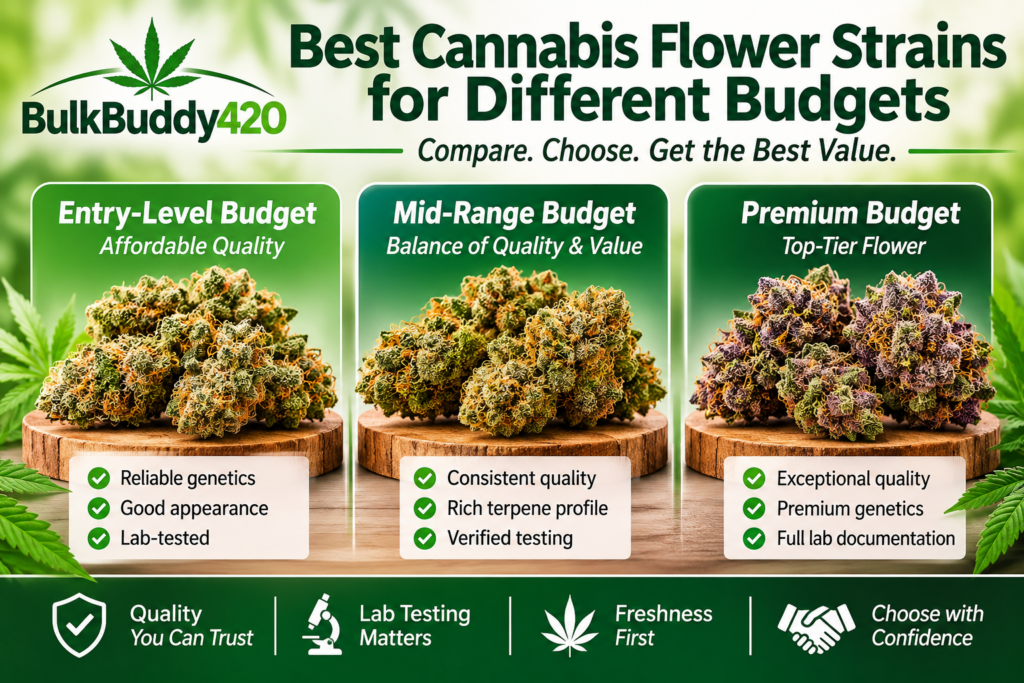
Best Cannabis Flower Strains for Different Budgets: A Complete Comparison Guide
Choosing cannabis flower involves more than comparing prices. Different cultivars, cultivation methods, flower grades, harvest conditions, and laboratory results can all influence product quality and value. When researching the best cannabis flower strains for different budgets, start by understanding what to compare and which quality indicators matter most.
This guide to the best cannabis flower strains for different budgets is designed to help readers compare product information across price levels without assuming that the cheapest option is poor quality or that the most expensive is automatically superior. The aim is to evaluate documented characteristics, freshness, consistency, and value. This framework keeps the best cannabis flower strains for different budgets grounded in product evidence rather than assumptions.
For buyers comparing the best cannabis flower strains for different budgets, the most useful approach is to assess each product on its own merits. Product availability, pricing, and legal requirements vary by location, and any cannabis-related activity should comply with applicable local laws.
Understanding Cannabis Flower Quality and Pricing
Cannabis flower pricing can vary because products are not all cultivated, processed, tested, packaged, or stored under identical conditions. Two products with similar strain names may have different characteristics depending on the grower, cultivation environment, genetics, harvest timing, and post-harvest handling.
When comparing the best cannabis flower strains for different budgets, consider these factors:
- Cultivation method: Indoor, greenhouse, and outdoor cultivation can involve different production costs and growing conditions.
- Flower appearance: Bud structure, trim consistency, visible trichomes, and overall presentation can support a preliminary visual assessment.
- Aroma and terpene information: Product information may describe its aromatic profile and measured terpene content.
- Laboratory testing: Batch documentation can provide cannabinoid results and relevant contaminant-testing information.
- Freshness: Harvest dates, packaging dates, storage conditions, and package integrity can influence product condition.
- Supplier reliability: Business credentials, traceability, and consistent documentation matter when evaluating suppliers.
For a deeper explanation of the factors that influence product costs, read our Cannabis Wholesale Pricing Explained guide. It provides useful context when comparing the best cannabis flower strains for different budgets against their quoted prices.
1. Entry-Level Budget: Evaluating Affordable Cannabis Flower
Entry-level products may appeal to buyers working within a limited budget. However, affordability should not replace basic quality and compliance checks. The best cannabis flower strains for different budgets are not necessarily the lowest-priced products; they are options whose documented characteristics justify their cost.
When evaluating lower-priced flower, pay attention to:
- Consistent appearance across the available batch.
- Proper trimming and reasonable bud condition.
- Clear packaging and traceable batch information.
- Available laboratory testing documentation.
- Appropriate storage and handling.
Some cultivars that buyers may encounter in different market segments include Northern Lights, Blue Dream, and other established varieties. Their presence in an entry-level price category is not guaranteed; actual pricing depends on the producer, market, location, and batch. This is important when comparing the best cannabis flower strains for different budgets rather than relying on strain names alone.
What to Avoid
Do not assume unusually low prices represent good value. Missing documentation, damaged packaging, inconsistent product descriptions, or unexplained differences between advertised and tested cannabinoid values should prompt further investigation. A careful review is more useful than choosing from a list of the best cannabis flower strains for different budgets based only on price.
2. Mid-Range Budget: Balancing Quality and Value
Mid-range flower options may offer a balance between product presentation, cultivation consistency, and price. Buyers comparing this category should look beyond strain names and advertised THC percentages. A sensible comparison of the best cannabis flower strains for different budgets considers the full product record.
Consider examining:
- Bud density and structural consistency.
- Trim quality and visible trichome coverage.
- Available cannabinoid and terpene profiles.
- Harvest and packaging information.
- Laboratory results linked to the specific batch.
Popular cultivar names that may appear in this segment include Wedding Cake, Gelato, and OG Kush. These names describe widely recognized cannabis varieties, but they do not establish a universal grade or price category. The best cannabis flower strains for different budgets will vary with the actual batch, grower, and market. Review the supporting information before treating any cultivar as a budget recommendation.
For buyers comparing different flower grades, our Best Cannabis Flower for Bulk Buyers article explains how to assess appearance, freshness, cultivation methods, and supplier quality.
3. Premium Budget: Evaluating Higher-Grade Flower
Premium-priced flower is often marketed around cultivation standards, presentation, genetics, production consistency, and detailed product information. However, premium positioning should be supported by evidence rather than marketing language alone. This principle applies equally when researching the best cannabis flower strains for different budgets.
When assessing higher-priced products, consider:
- Well-maintained flower structure and consistent trimming.
- Careful handling and suitable packaging.
- Documented batch information and laboratory results.
- Clearly described cultivation and production methods.
- Consistent product characteristics across samples or batches.
Examples of cultivars that may be marketed in premium product ranges include Gelato selections, Wedding Cake selections, and certain OG varieties. Their actual classification depends on the specific product and producer. A premium label alone does not establish that a product belongs among the best cannabis flower strains for different budgets.
Remember that labels such as AAA and AAAA are not universal industry grading standards. A seller’s grade should be supported by clearly explained evaluation criteria and product documentation.
4. Popular Cannabis Flower Strains to Compare
Strain names can help buyers identify cultivars, but they should not be treated as guarantees of quality, potency, or price. The same cultivar can differ significantly between growers and production batches. This is why comparisons of the best cannabis flower strains for different budgets should focus on the specific product rather than the name alone.
| Cultivar | Commonly Described Profile | What to Compare |
|---|---|---|
| Blue Dream | Often described with sweet, berry-like, and herbal notes | Batch consistency, aroma information, and testing |
| Northern Lights | Often described with earthy and pine-like notes | Flower condition, cultivation details, and freshness |
| OG Kush | Often described with earthy, citrus, and fuel-like notes | Product identity, terpene information, and batch records |
| Wedding Cake | Often described with sweet and dessert-like notes | Trim quality, structure, and laboratory documentation |
| Gelato | Often described with sweet, creamy, and fruity notes | Genetic identification, aroma profile, and consistency |
These are general descriptions, not guaranteed characteristics of every batch. Cultivation conditions and individual product differences can change the final profile. Use these comparison points when reviewing the best cannabis flower strains for different budgets in your market.
5. Indoor, Greenhouse, and Outdoor Flower: Does Cultivation Affect Price?
Cultivation method is one factor that may influence production costs and final pricing. However, the growing environment alone does not establish whether a product is superior. Buyers evaluating the best cannabis flower strains for different budgets should consider actual quality and documentation alongside the cultivation label.
Indoor Cultivation
Indoor production allows growers to control environmental conditions more closely. Lighting, temperature, humidity, and ventilation can be managed within a controlled facility. These systems may involve higher operating expenses.
Greenhouse Cultivation
Greenhouse production combines elements of controlled cultivation with natural sunlight. Actual production methods vary, including the degree of environmental control and supplemental lighting.
Outdoor Cultivation
Outdoor cultivation relies more heavily on natural environmental conditions. Production costs can differ from indoor operations, but weather, pests, and seasonal conditions may influence consistency.
Rather than choosing a product based solely on its cultivation label, compare documented quality, batch consistency, testing, and price. This makes comparisons of the best cannabis flower strains for different budgets more meaningful.
6. Why THC Percentage Should Not Determine Your Entire Budget
THC percentage is one measurement used to describe cannabis flower, but it is not a complete measure of product quality. A higher number does not automatically mean a better product or better value. The best cannabis flower strains for different budgets should be evaluated using several relevant indicators, not a single number.
Buyers should examine available cannabinoid information alongside batch identity, terpene information, laboratory results, and other quality indicators.
Health Canada’s official guide to reading cannabis product labels explains how THC, CBD, batch information, and other details are presented on regulated Canadian cannabis products. Its specific labelling requirements apply to Canada, so buyers should consult the relevant regulator in their own jurisdiction.
7. Laboratory Testing and Product Documentation
Laboratory documentation is an important part of evaluating regulated cannabis products. A Certificate of Analysis (COA) can provide information about the tested batch, cannabinoid profile, and relevant contaminant results. For anyone comparing the best cannabis flower strains for different budgets, batch-specific documentation is more useful than unsupported promotional claims.
When reviewing a COA, check:
- Whether the report identifies the same product and batch being evaluated.
- Whether the laboratory is appropriately authorized in the relevant jurisdiction.
- Which cannabinoids were tested and reported.
- Whether relevant pesticide, microbial, heavy-metal, and other contaminant tests are included where required.
- Whether the report is current and traceable to the product.
The Illinois Department of Agriculture’s guide to reading a Certificate of Analysis explains how to examine batch details, potency information, and safety-testing results. This is an Illinois resource, not a universal regulatory standard.
8. How to Compare Cannabis Flower Value Across Budgets
A useful comparison considers more than the advertised price. Buyers should evaluate the product’s documented quality, condition, consistency, and traceability against its total cost. This is a practical way to assess the best cannabis flower strains for different budgets without relying on marketing labels.
| Comparison Factor | Questions to Ask |
|---|---|
| Price | What is included in the quoted price? |
| Quality | Are the product characteristics clearly documented? |
| Testing | Is there a traceable batch-specific COA? |
| Freshness | Are harvest, packaging, and storage details available? |
| Consistency | Do samples and batch records support the product description? |
| Supplier | Can the business and its required licences be independently verified? |
For business buyers, it is also important to understand minimum order quantities, transportation costs, applicable taxes, and other transaction terms. Our Cannabis Wholesale vs Retail guide explains some of the differences between these purchasing models.
9. Common Mistakes When Comparing Cannabis Flower by Budget
Even a detailed comparison of the best cannabis flower strains for different budgets can be misleading if buyers overlook basic checks. Avoid these common mistakes:
- Choosing by THC alone: Cannabinoid percentages do not tell the entire quality story.
- Assuming expensive means superior: A premium price should be supported by product evidence.
- Ignoring batch differences: Products with the same cultivar name can vary between harvests.
- Overlooking laboratory documentation: Product descriptions are not substitutes for relevant testing records.
- Assuming grades are universal: Seller-assigned grades may use different criteria.
- Ignoring storage: Poor handling can affect product condition regardless of its original price.
- Skipping supplier verification: Business credentials and applicable licensing should be checked before entering a transaction.
Frequently Asked Questions
What Are the Best Cannabis Flower Strains for Different Budgets?
There is no universal strain-to-budget ranking. Blue Dream, Northern Lights, OG Kush, Wedding Cake, and Gelato are examples of recognized cultivar names that may appear across different market segments. Their prices and quality depend on the producer, location, cultivation method, and individual batch. Compare the actual product and its documentation rather than assuming a cultivar always belongs in one price category. That is the most reliable way to compare the best cannabis flower strains for different budgets.
Does Expensive Cannabis Flower Always Have Better Quality?
No. Higher prices may reflect cultivation expenses, production methods, packaging, or market positioning. Buyers should evaluate documented quality and batch information instead of relying on price alone.
Is Indoor Cannabis Flower Always Better Than Outdoor Flower?
No. Indoor, greenhouse, and outdoor cultivation each have different production conditions. Actual quality depends on genetics, cultivation practices, harvesting, processing, testing, and storage.
Are AAA and AAAA Cannabis Grades Standardized?
Not universally. Grade labels can vary between sellers and markets. Buyers should ask what criteria are used and request supporting product information.
Should THC Percentage Be the Main Factor When Comparing Flower?
No. THC is one measurement. Batch-specific laboratory results, product condition, cannabinoid information, terpene data, and supplier documentation also matter.
Why Should Buyers Request a Certificate of Analysis?
A COA provides laboratory information associated with a particular sample or batch. It helps buyers review cannabinoid results and relevant contaminant testing, subject to the laboratory and regulatory requirements that apply locally.
Final Thoughts: Finding Value at Every Budget Level
Comparing cannabis flower across different budgets requires a balanced approach. Strain names, cultivation methods, visual appearance, laboratory results, freshness, and supplier reliability all contribute to a more informed evaluation. The best cannabis flower strains for different budgets are the products whose documented characteristics and total costs meet the buyer’s legitimate requirements.
The most expensive product is not automatically the best choice, and the lowest-priced option should not be selected without checking its quality and documentation. Use these principles whenever you compare the best cannabis flower strains for different budgets. A clear comparison of product characteristics and total costs is a more reliable way to assess value.
For additional information, explore the BulkBuddy420 shop page and our related educational guides. Any cannabis-related transaction should comply with the licensing, age, possession, distribution, and other applicable laws in the relevant jurisdiction.