
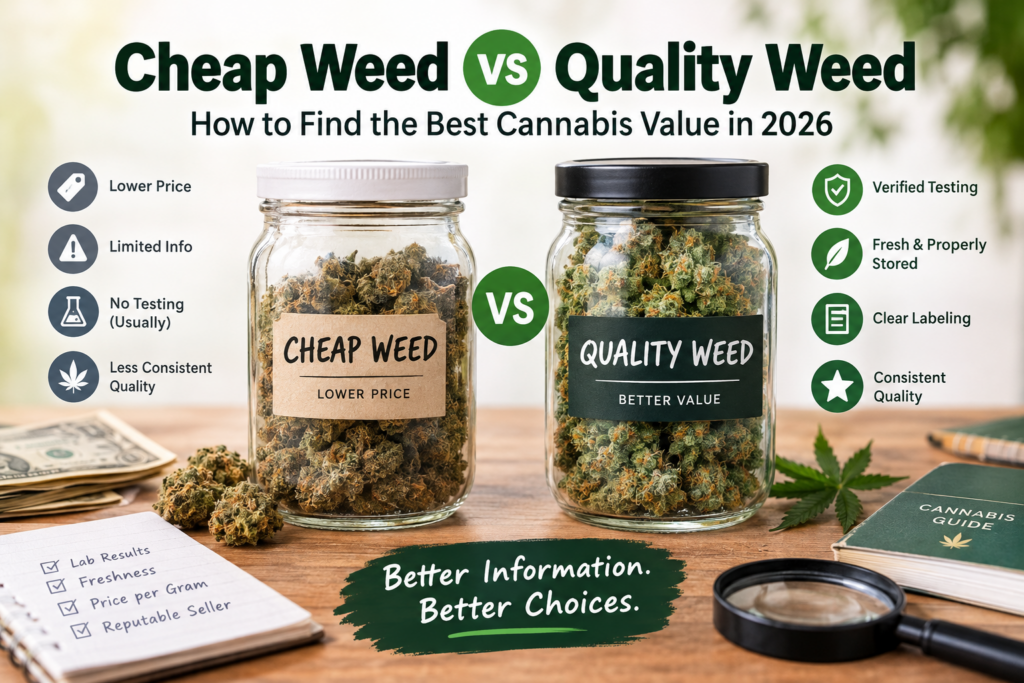
Cheap Weed vs Quality Weed: How to Find the Best Cannabis Value in 2026
When comparing cheap weed vs quality weed, the lowest advertised price does not always represent the best value. Product quality, freshness, lab testing, storage, and accurate labeling can all affect what you receive for your money. In this guide, learn how to evaluate cannabis products more carefully and compare their overall value before making a purchase.
1. Cheap Weed vs Quality Weed: What Is the Difference?
The main difference between inexpensive cannabis and higher-priced cannabis is not always potency. Differences may include cultivation methods, handling, freshness, consistency, testing, packaging, and the amount of information available about a product.
When comparing cheap weed vs quality weed, consider the complete product rather than relying on price alone. A lower-priced option may provide reasonable value when it is fresh, properly stored, accurately labeled, and tested where required. A more expensive product may offer additional quality controls or a more consistent experience, but a higher price does not automatically guarantee better quality.
The goal is to compare products using reliable information. Look at the product description, available laboratory results, packaging date, cannabinoid information, and seller transparency before drawing conclusions about value.
2. Check Laboratory Testing and Product Transparency
Laboratory testing can help consumers understand what a cannabis product contains. Where testing is legally required, licensed products may be tested for cannabinoid content and certain contaminants, depending on the applicable regulations.
When evaluating cheap weed vs quality weed, look for accessible test information from a credible laboratory. Depending on the product and local requirements, a certificate of analysis may provide details about cannabinoids, pesticides, heavy metals, microbial contaminants, or residual solvents.
- Verify product information: Check whether the test report corresponds to the specific product or batch.
- Review cannabinoid results: Compare the listed THC and CBD content with the available test information.
- Check testing details: Look for the laboratory name, report date, and batch or lot information when provided.
- Be cautious of unsupported claims: Marketing statements are not a substitute for verifiable testing information.
Testing does not guarantee that every product attribute is ideal, but transparent and verifiable information can help you make a more informed comparison.
3. Evaluate Freshness, Storage, and Packaging
Freshness and storage conditions can influence the quality of cannabis flower. Excessive heat, light, humidity, or air exposure may contribute to changes in aroma, texture, and cannabinoid or terpene content over time.
When comparing cheap weed vs quality weed, examine the available packaging information and storage guidance. Where applicable, check the packaging date, batch details, and whether the container is sealed appropriately. Avoid relying on appearance alone because visual inspection cannot confirm cannabinoid content or rule out contaminants.
For flower, excessively dry material may crumble easily, while unusual moisture or visible signs of mold are reasons for caution. Do not use cannabis that appears moldy or otherwise contaminated. Smell and appearance can provide limited clues, but neither replaces laboratory testing.
4. Do Not Judge Quality by THC Percentage Alone
THC percentage is one measure of a cannabis product, but it is not a complete measure of quality. Other considerations include cannabinoid composition, terpene content, freshness, consistency, testing, and the type of product being compared.
In a cheap weed vs quality weed comparison, avoid assuming that the product with the highest THC percentage automatically offers the best value. Percentages can be reported differently across product types, and results should be interpreted in context. A higher number does not establish that a product is safer, fresher, or more suitable for an individual consumer.
Compare similar products whenever possible. For example, compare flower with flower rather than comparing flower directly with concentrates or infused products. Consider the amount of product, the stated cannabinoid content, the available test results, and the price together.
5. Compare the Total Price, Not Just the Advertised Price
Price comparisons are more useful when products are measured on a consistent basis. An advertised price may not reflect the final amount payable, and products of different sizes can be difficult to compare at a glance.
When evaluating cheap weed vs quality weed, consider the listed quantity, price per unit, any applicable taxes, and any additional charges disclosed before purchase. For example, dividing the product price by the listed weight can help compare the unit price of similar flower products.
- Compare the same product category and similar quantities.
- Calculate the price per gram or another appropriate unit.
- Check whether taxes and other charges are included in the advertised price.
- Review the seller’s policies and product information before completing a transaction.
- Consider whether the product has sufficient verifiable information to justify its price.
The cheapest option is not necessarily the best deal if the product information is incomplete or its quality cannot be verified. Equally, a higher price does not automatically mean that a product offers better value.
6. Understand Why Some Cannabis Products Cost More
Several factors can influence cannabis pricing. These may include cultivation and processing methods, labor, testing, packaging, distribution costs, product availability, and local market conditions. Regulations and taxes can also affect prices in legal markets.
Some products may cost more because the seller provides more detailed testing information, consistent batches, specialized production methods, or improved packaging. However, these differences should be assessed using evidence rather than assumed from branding or price alone.
When comparing cheap weed vs quality weed, ask what measurable differences explain the price. Reliable product details and transparent testing information are more useful than unsupported claims about premium quality.
7. Choose a Reputable, Legally Compliant Seller
Seller transparency is an important part of evaluating cannabis products. Depending on where you live, cannabis sales may be restricted to licensed businesses and subject to specific rules for testing, labeling, packaging, and age verification.
Before buying, confirm the applicable local laws and whether the seller is authorized to operate in your area. Review the seller’s contact information, product descriptions, policies, and available testing documentation. Be cautious when a seller makes guarantees that cannot be verified or provides little information about product origin and quality.
A clear purchasing process and accurate product information can help consumers understand what is being offered. They cannot, by themselves, prove that a product is high quality, so evaluate the available evidence carefully.
8. Common Mistakes to Avoid When Comparing Cannabis Prices
Comparing prices without checking other product details can lead to misleading conclusions. Avoid these common mistakes when deciding between lower-priced and higher-priced products.
- Choosing by price alone: Compare freshness, testing, quantity, and product information alongside cost.
- Assuming higher THC means better quality: THC percentage is only one part of the overall comparison.
- Ignoring the product category: Different cannabis formats are not always directly comparable.
- Overlooking storage and dates: Available packaging and storage information may help you assess freshness.
- Trusting unsupported marketing: Claims about potency, purity, or premium quality should be supported by reliable information.
- Skipping legal requirements: Check the laws and purchasing restrictions that apply to your location.
Taking a few minutes to review these details makes a comparison more meaningful than simply choosing the lowest price or the highest advertised THC percentage.
9. A Practical Checklist for Finding Better Cannabis Value in 2026
Use this checklist to compare product information consistently. Not every detail will be available for every product, and requirements vary by location, so treat missing information as a reason to investigate rather than as proof of poor quality.
- Compare products in the same category and similar quantities.
- Calculate the price per unit where appropriate.
- Review available laboratory testing and batch information.
- Check the stated cannabinoid content without relying on THC percentage alone.
- Look for packaging dates and suitable storage information where available.
- Read the product description and verify important claims.
- Check seller credibility and applicable licensing requirements.
- Review the total price and any disclosed additional charges.
- Confirm that the product and transaction comply with local laws.
This approach helps make cheap weed vs quality weed comparisons more consistent. It also reduces the risk of mistaking a low advertised price or an impressive marketing claim for evidence of overall value.
Conclusion: Finding the Best Value Without Guesswork
Finding good cannabis value in 2026 means looking beyond the price tag. Product freshness, transparent testing, accurate cannabinoid information, appropriate packaging, seller credibility, and total cost all contribute to a more informed comparison.
When weighing cheap weed vs quality weed, focus on verifiable details and compare similar products on a consistent basis. A lower-priced product may offer reasonable value when its quality information is reliable, while a premium-priced option should provide clear reasons for its higher cost. Neither price nor THC percentage alone tells the whole story.
For additional information about cannabis products and consumer safety, consult the California Department of Cannabis Control’s consumer resources. Reviewing official guidance alongside product information can help you make more informed decisions while following the laws that apply to your location.